
Read More
2026-08-02 5 mins read
1PL, 2PL, 3PL, 4PL, 5PL: The Logistics Tiers Explained and Where the Importer of Record Fits
Read More

Trade Compliance
Logistics
You’ve seen HS codes on invoices, HTS codes on import forms, and perhaps even HTSUS in U.S. customs documentation. It’s easy to assume they’re the same—but they serve distinct purposes in global trade. Both play a crucial role in how goods are classified and cleared through customs. Understanding the difference helps importers and compliance teams ensure accurate filings, prevent costly delays, and maintain full trade compliance, all essential elements of a structured regulatory compliance framework that governs how goods are classified, valued, and cleared at every border crossing.
So, what exactly sets HS and HTS apart—and why does it matter for your next shipment?
The Harmonized System (HS) Code is a globally standardized six-digit classification used by over 200 economies to identify traded goods. It forms the foundation for all national tariff schedules and ensures consistency in global trade reporting.
- Chapters (2 digits): Broad product category
- Headings (2): Subcategory within the chapter
- Subheadings (2): Specific product line
The World Customs Organization (WCO) maintains and updates the HS roughly every five years to reflect new technologies and trade trends.
A Harmonized Tariff Schedule (HTS) code extends the HS framework to 8–10 digits, adding country-specific detail used for duty assessment and import reporting.
- First 6 digits: Universal HS base
- Final digits: National extensions defining tariff rates and statistical categories
In the United States, importers use the HTSUS (Harmonized Tariff Schedule of the United States), administered by the U.S. International Trade Commission (USITC), for every customs entry and duty declaration.
While the HS provides a universal foundation, the HTS adds country-specific detail for import duties and reporting. The table below shows how they align in practice:
Aspect | HS | HTS |
|---|---|---|
Purpose | Universal product classification | Country-specific import duty & statistics |
Digits |
Note:
“Schedule B” is the U.S. 10-digit export code administered by the U.S. Census Bureau. It is not a substitute for HTS on imports.
Understanding the relationship between HS and HTSUS becomes easier with a practical example.
Step 1 – Start with the HS Code
Description: Machines for the reception, conversion, or transmission of data.
Purpose: Global classification recognized under the WCO Harmonized System.
Each code system serves a specific purpose depending on the direction of trade and documentation requirements. Use this quick checklist to know when each applies:
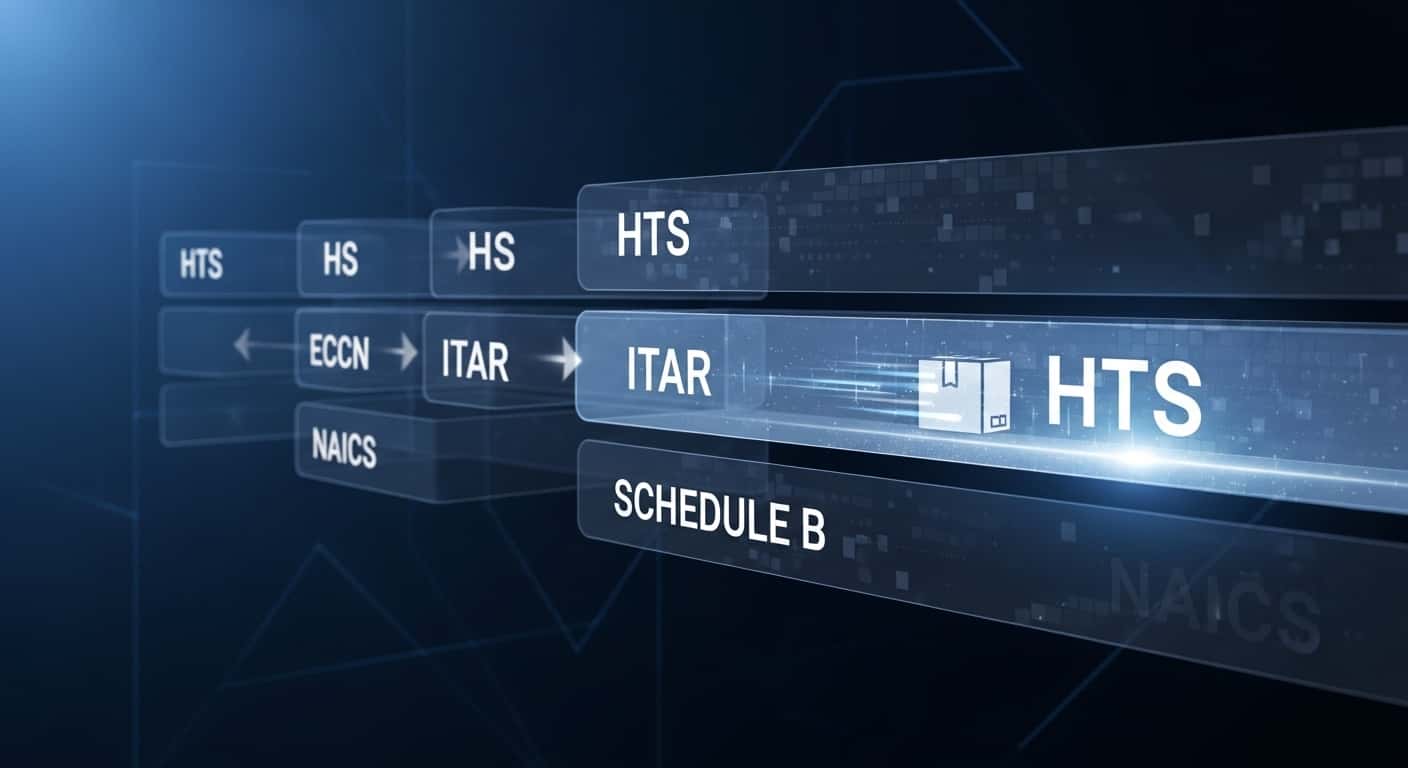
HS – For global references, supplier quotations, or documentation where no specific destination country is defined.
HTSUS – For U.S. imports, including customs entries, tariff assessments, and duty calculations.
Schedule B – For U.S. exports, used in AES/EEI electronic filings and trade statistics collected by the U.S. Census Bureau.
Even experienced importers make classification errors that can lead to penalties or shipment delays. Here are the most frequent ones—and how to prevent them:
Using only HS on a U.S. import entry
Always file the full 10-digit HTSUS code for customs clearance.
Copying a supplier’s local code
Always verify the last digits for the destination country's tariff schedule before filing. Working with IOR for customs accuracy ensures the correct national HTS extension is applied at the destination, preventing misclassification penalties before the shipment reaches the border.
Ignoring WCO or USITC updates
Revalidate product codes regularly to stay compliant with the latest tariff changes.

Need help with Classification?
Explore these official resources to verify codes and stay compliant with the latest tariff updates:
WCO – Harmonized System – Structure, classification principles, and update cycles.
🇺🇸 USITC – HTS Search – Official U.S. Harmonized Tariff Schedule database.
U.S. Census – Schedule B Search – U.S. export classification and statistical reporting.
CBP – Classification Basics – Importer guidance, compliance requirements, and penalties for misclassification.
Every shipment starts with the right code. Accurate classification determines not only the duties you pay but also how smoothly your goods move through customs.
Regularly review and update your HS or HTSUS codes to stay compliant and avoid costly disruptions.
FAQs
Yes. The HTS builds on the 6-digit HS code by adding country-specific digits used to determine duties and collect trade statistics.
No. U.S. imports must be filed under the full 10-digit HTSUS code for customs clearance and accurate duty calculation.
The CBP may impose fines, delay entry, or require corrections if goods are misclassified under the wrong HTS code.
Yes. Each country extends the global HS differently, adding its own suffixes for tariff and statistical purposes.


6
8–10 (U.S. = 10) |
Governing Body | WCO | National authority (e.g., USITC in the U.S.) |
Use Case | Global trade reference & negotiations | Customs import declarations, where the full HTS code determines the exact import duty by HS code applied to each shipment, including any preferential rates under active trade agreements. |
Example | 8517.62 | 8517.62.00.10 (U.S.) |
Step 2 – Expand to the U.S. HTSUS
Description: Networking equipment.
Purpose: U.S.-specific classification used to determine duty rates and statistical reporting — the exact rates applied depend on tariff types explained at the national level, including ad valorem, specific, and compound structures that vary by product
Step 3 – Result
HS → HTSUS Transition: The first six digits (8517.62) identify the global product type, while the final four (.00.10) specify U.S. import requirements and duties.
For Intense: A technology importer reclassified routers under 8517.62.00.10 and reduced import duties by 3%, demonstrating how accurate classification directly saves costs and prevents customs delays.